Monday, April 7, 2008

Cyber dissidents, you know I love ‘em

I'm currently working on an update for both my semester projects. They are coming together nicely. While I don't have too much time, I had promised myself I would try to blog more. And I have failed to keep that promise as well as I would have liked. But I did come across something today that I thought was absolutely fabulous, perhaps for me and not the Egyptian government though.

In my International News Communication class, we're exploring different online publications in various regions of the world. It's often difficult to judge the publications because ultimately I'm American, and more often than not, the journalistic practice differs from mine. I have quite the fascination with Al Jazeera, though. My intrigue began the Iraq war and has only grown since I saw Control Room over a year ago. I often play clips for some of my classes, to give them a sense of how the journalists who work for the organization feel about their roles as journalists. This opens a whole other discussion on cultural variance and the role of journalism.

My point was simply to illustrate what Tomlinson called the "complex connectivity", a term that I think he might have borrowed from Hannerz. Tomlinson argued cultural practices are at the heart of globalization, and I tend to agree. I have begun to see the organization of political or economic life as forms of cultural exchange, for we organize both symbolically. Our choice between capitalism and communism is predicated on how we organize our understanding of the world, how we make sense of life and everything around us. This is why I think die hard capitalists who give nothing back to world are complete assholes.

Tomlinson also talked about disembedding, the idea of cultural artifacts removed from their original context, and the compression of time and space. I believe the idea of both time and space is very pertinent to the point that I want to make today. Without this compression, it would be difficult to show my students this:


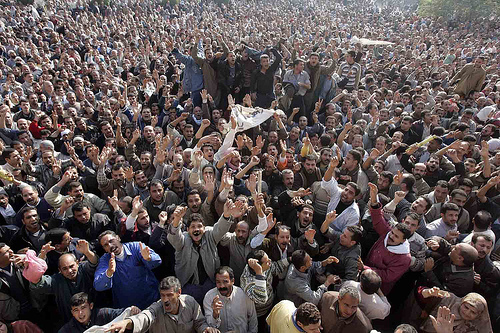
Without it, we would need to rely on what many U.S. critics of Al Jazeera say about the news organization, being unfortunately bound to available news sources and historians to help us sort out the "facts". Rather we have a multidimensional world that facilitates a prism of varying perspectives on current events. The one I point out today is the story on the protests in Egypt. The story topped the homepage of Al Jazeera's website, of course coupled with a dramatic photo of an overturned car. There were many elements of the story that I found fascinating. Low wages and little access to staple food items would piss me off, and apparently these men and women in Egypt feel the same way. They are frustrated. The opinion poll, which is highlighted like a pull quote, can be seen in the screen shot below. But the most peculiar item, the coolest thing about this story, was the apparent online organization of the protests. I would not have believed it myself unless I saw it. The government is upset with a group identified only as "cyber dissidents" who are organizing protests in where of all places? The social networking site, Facebook. What better illustration of "complex connectivity" and "hybridity" is there?


AddThis Social Bookmark Button

Saturday, March 8, 2008

Where does the news come from?

Or the more succinct point, what is the cultural logic of globalized news? Over the past few weeks, I have contemplated my research topics for this semester. Ultimately and ideally, they would be linked, so they could fit into my dissertation. And of course, because I finish my coursework in the fall, I should probably begin thinking about my dissertation topic.

A number of things interest me, which makes choosing just one a really difficult endeavor. My interest in international studies has expanded to include most everything that falls under the umbrella of globalization, particularly news. In the past, researchers carefully scrutinized the flows of information, as well they should. The flow of information was (perhaps still is)asymetrical, and embedded inevitably in the information disseminated from, let's say, the United States, resides our cultural logic. Within each word, within the organization of news stories, the artwork, encapsulated within a news story and its package exists an ordering process that seeks to impose upon the world a perspective of how to experience, how to know, and how to describe phenomena.

To examine these flows, cultural imperialism presented a way to dismantle these flows, and illustrate their possible problems. The primary concern that I can derive from the "cultural imperialism thesis", as John Tomlinson calls it, resides in how this cultural logic - as it becomes globalized through the one-way flow of information - might change or impede upon the local culture. Of course as Tomlinson indicates, and scholars like Kraidy and Pieterse illustrate, the cultural imperialism thesis does not do the resilience and flexibility of culture justice. My concern here is of course: what is American, and what is global?

These two words in particular have concerned me as I read through the literature about globalization and media, especially as the descriptors, global and Americanized. It seems at some point those ideas affiliated with "Westernized" began to morph into "Americanized". While I bring my own understanding of "Americanized" news, I still feel a bit hazy on what is meant. If we mean that Americanized news exist in news items that are constructed as commodities, then I'm not sure what to call Reuters' products other than Britianized news. Likewise, if we mean that Americanized news are news items that belong to an American model of providing information necessary for facilitating political participation, again, I'm not sure what we can consider other news products from non-U.S. countries that might hold similar views. The Kosovo case illustrates the differences between the United States and European countries; they have their own conceptions of free speech, uses of news media, and philosophies concerning the role of media in society.

Additionally, I am equally perplexed by the idea of "global", especially when the term is paired with "news". I'm sure the idea of "global" media products are the focus of a number of countries; however, I think Reuters and the Associated Press are my primary concern. Both state they are companies that provide news and information on a global level. So what do they mean by that? If Associated Press is an American organization, then can it be global? Or can we discount its base of operation? And what are global news items? Can I infer from AP's claim of existing as "the essential global news network" that a news organization anywhere can know almost everything that transpires all the time? Likewise, Reuters is a British company that claims to be a "global information company". Can I infer that Reuters can procure and disseminate information from all points of the globe?

There are many finer nuances in these ideas. When we define news, what exactly do we mean? What news values are used to determine the selection of news? Who decides in local news organizations what routines must be followed? What ownership structure exists in areas of Africa, where the news media might be relatively new compared to the European or Euro-American news media? I hope to tackle each of these in turn, probing what is meant by both these words. It occurs to me that many outside the United States might have just as skewed an idea of the U.S. as we have of their countries. Because I am an American, a journalist, and a scholar, I can't help but ask these questions, especially when I know the complexities, nuances, and textures of Euro-American culture are never properly represented in media. While the media might provide us a picture, it is completely flat; it lacks the social context of place.

Take for example this picture:


Of course, not everyone in the U.S. has access to this type of food. In fact, I found food items in the East that are dramatically different from the Midwest or Southwest. Even while we have a sense of the "imagined community" as Anderson suggests, we lack the social context from the local. We have misconceptions and biases about one another, just as perhaps Bengalis might have about other Indians, or those from Mexico might have about other Latin Americans. So my question to the world would be: What is an American? Ultimately you must search your mind for what elements and ideas came together to form your conception in the first place.

Especially if the original cultural item is removed from its context:


AddThis Social Bookmark Button

Tuesday, March 4, 2008

Good news from North Philly...

As this semester flies by and I soldier on, attempting to keep up with the reading as well as everything occurring globally, I received a bit of news this morning. A couple of weeks ago I applied for the Temple Writing Academy, which provides a variety of classes for high school students from North Philadelphia.

For those who are not well-acquainted with this area, North Philly exists as a monument to the cracks in both the capitalist and democratic systems. When I first drove through this area - on my first trip to Philly - I cried. I could never imagine growing up in a place of crumbling concrete, that seems untouched by recent development and ignored by policy makers. While I cringe at thinking myself a great "white" savior, I am happy at the opportunity to meet these young people, to hear their narratives, and to come together with them to learn. It promises so many opportunities.

I have not thought at depth about the curriculum, but I did pitch a global literature class. I have been reading "Graceland" by Chris Abani, and I had the great fortune to speak with educators like Juan Devis last summer as a part of the Media Literacy Lab's research into educators' uses of copyrighted materials. I will more than likely contact these gentlemen, to ask their opinion - other books to read. I think these young people will no doubt understand the colonial and postcolonial human traps and the consequences that have grown from these.

I am estatic, and I welcome suggestions...


AddThis Social Bookmark Button

Tuesday, February 19, 2008

Kosovo Declaration of Independence

Here is the Declaration of Independence, taken directly from the website for the Assembly of Kosovo. Click here to learn more. I will respond to the press coverage of this in the next couple of days. It's not every day that a territory posts its declaration on the internet, or is it?

Kosovo Declaration of Independence

Convened in an extraordinary meeting on February 17, 2008, in Pristina, the capital of Kosovo,

Answering the call of the people to build a society that honours human dignity and affirms the pride and purpose of its citizens,

Committed to confront the painful legacy of the recent past in a spirit of reconciliation and forgiveness,

Dedicated to protecting, promoting and honoring the diversity of our people,

Reaffirming our wish to become fully integrated into the Euro-Atlantic family of democracies,

Observing that Kosovo is a special case arising from Yugoslavia's non-consensual breakup and is not a precedent for any other situation,

Recalling the years of strife and violence in Kosovo, that disturbed the conscience of all civilised people,

Grateful that in 1999 the world intervened, thereby removing Belgrade's governance over Kosovo and placing Kosovo under United Nations interim administration,

Proud that Kosovo has since developed functional, multi-ethnic institutions of democracy that express freely the will of our citizens,

Recalling the years of internationally-sponsored negotiations between Belgrade and Pristina over the question of our future political status,

Regretting that no mutually-acceptable status outcome was possible, in spite of the good-faith engagement of our leaders,

Confirming that the recommendations of UN Special Envoy Martti Ahtisaari provide Kosovo with a comprehensive framework for its future development and are in line with the highest European standards of human rights and good governance,

Determined to see our status resolved in order to give our people clarity about their future, move beyond the conflicts of the past and realise the full democratic potential of our society,

Honouring all the men and women who made great sacrifices to build a better future for Kosovo,

1. We, the democratically-elected leaders of our people, hereby declare Kosovo to be an independent and sovereign state. This declaration reflects the will of our people and it is in full accordance with the recommendations of UN Special Envoy Martti Ahtisaari and his Comprehensive Proposal for the Kosovo Status Settlement.

2. We declare Kosovo to be a democratic, secular and multi-ethnic republic, guided by the principles of non-discrimination and equal protection under the law. We shall protect and promote the rights of all communities in Kosovo and create the conditions necessary for their effective participation in political and decision-making processes.

3. We accept fully the obligations for Kosovo contained in the Ahtisaari Plan, and welcome the framework it proposes to guide Kosovo in the years ahead. We shall implement in full those obligations including through priority adoption of the legislation included in its Annex XII, particularly those that protect and promote the rights of communities and their members.

4. We shall adopt as soon as possible a Constitution that enshrines our commitment to respect the human rights and fundamental freedoms of all our citizens, particularly as defined by the European Convention on Human Rights. The Constitution shall incorporate all relevant principles of the Ahtisaari Plan and be adopted through a democratic and deliberative process.

5. We welcome the international community's continued support of our democratic development through international presences established in Kosovo on the basis of UN Security Council resolution 1244 (1999). We invite and welcome an international civilian presence to supervise our implementation of the Ahtisaari Plan, and a European Union-led rule of law mission. We also invite and welcome the North Atlantic Treaty Organization to retain the leadership role of the international military presence in Kosovo and to implement responsibilities assigned to it under UN Security Council resolution 1244 (1999) and the Ahtisaari Plan, until such time as Kosovo institutions are capable of assuming these responsibilities. We shall cooperate fully with these presences to ensure Kosovo's future peace, prosperity and stability.

6. For reasons of culture, geography and history, we believe our future lies with the European family. We therefore declare our intention to take all steps necessary to facilitate full membership in the European Union as soon as feasible and implement the reforms required for European and Euro-Atlantic integration.

7. We express our deep gratitude to the United Nations for the work it has done to help us recover and rebuild from war and build institutions of democracy. We are committed to working constructively with the United Nations as it continues its work in the period ahead.

8. With independence comes the duty of responsible membership in the international community. We accept fully this duty and shall abide by the principles of the United Nations Charter, the Helsinki Final Act, other acts of the Organization on Security and Cooperation in Europe, and the international legal obligations and principles of international comity that mark the relations among states. Kosovo shall have its international borders as set forth in Annex VIII of the Ahtisaari Plan, and shall fully respect the sovereignty and territorial integrity of all our neighbors. Kosovo shall also refrain from the threat or use of force in any manner inconsistent with the purposes of the United Nations.

9. We hereby undertake the international obligations of Kosovo, including those concluded on our behalf by the United Nations Interim Administration Mission in Kosovo (UNMIK) and treaty and other obligations of the former Socialist Federal Republic of Yugoslavia to which we are bound as a former constituent part, including the Vienna Conventions on diplomatic and consular relations. We shall cooperate fully with the International Criminal Tribunal for the Former Yugoslavia. We intend to seek membership in international organisations, in which Kosovo shall seek to contribute to the pursuit of international peace and stability.

10. Kosovo declares its commitment to peace and stability in our region of southeast Europe. Our independence brings to an end the process of Yugoslavia's violent dissolution. While this process has been a painful one, we shall work tirelessly to contribute to a reconciliation that would allow southeast Europe to move beyond the conflicts of our past and forge new links of regional cooperation. We shall therefore work together with our neighbours to advance a common European future.

11. We express, in particular, our desire to establish good relations with all our neighbours, including the Republic of Serbia with whom we have deep historical, commercial and social ties that we seek to develop further in the near future. We shall continue our efforts to contribute to relations of friendship and cooperation with the Republic of Serbia, while promoting reconciliation among our people.

12. We hereby affirm, clearly, specifically, and irrevocably, that Kosovo shall be legally bound to comply with the provisions contained in this Declaration, including, especially, the obligations for it under the Ahtisaari Plan. In all of these matters, we shall act consistent with principles of international law and resolutions of the Security Council of the United Nations, including resolution 1244 (1999). We declare publicly that all states are entitled to rely upon this declaration, and appeal to them to extend to us their support and friendship.


AddThis Social Bookmark Button

Thursday, February 14, 2008

The political economy of rock, paper, scissors

Sometimes it occurs to me, though it is reinforced time and again in my readings, how we take for granted certain parts of our culture. What often seems self-evident is something overlooked, especially when the cultural artifact is so widely known. Nothing is so apparent than what we learn as children, such as stories or games. Rock, paper, scissors is but one example.

I'm not sure why I assumed most everybody would know about the game. It was a pervasive part of my childhood, cropping up when incredibly important decisions were needed or when consensus could not be reached. As a child, my neighborhood friends and I were prone to adventurous explorations, which sometimes required picking the kid who would wander into and check out what we perceived as dangerous territory. The deciding force behind who went first - the process that made it legitimate - was typically rock, paper, scissors.

And most Americans with whom I come into contact know this game. Hence my surprise when my friend from India acted with bewilderment when I suggested jokingly we should use a game of rock, paper, scissors to settle a decision over our reading for class. As we split up our Manuel Castells reading for our Globalized Media class, I hopped on "Geopolitics and the State"; my friend ended up with "Bolivia and Democracy," a reading she seemed unhappy about. Upon my suggestion, she politely conceded - as she is always apt to do - that she would accept the reading that she received.

However, one of our peers and I, in sensing her confusion over the game, decided to explain the rules. We went round and round for about five to ten minutes before she politely said she had it, with a slight impatient huff and a wave of her hand signaling that she felt the game absurd. Why is the paper better than the rock? Heck, I don't know.

So I began to think about it. Why is it that my friend who has been in United States for some time lacked knowledge about this game? Even more, what did the game say about Americans? The political economy aspect of this game occurred to me as I read through the readings for my classes this week; however, the search for information is always a good place to begin.

I am quite sure if I had an overabundance of leisure time, I would devote that time to more constructive endeavors and not rock, paper, scissors. However, I will say as I entered the term into the Google engine and clicked "search", almost a million web pages came up. I went through several, and found several explanations of the game. I even found the website for the World Society of RPS, a factoid that I probably could have lived without. I also found our symbolic representations of our symbolic representations enlightening and amusing. For example, check out this graphic explanation of the rules from corkinthewater:


Or this beer commercial:


You can visit this website for more information.

I can imagine one would feel a bit of cultural vertigo from experiencing the game without a context by which to understand it. And in rethinking my knowledge of the game, as well as its meaning, I wondered how it related to the perplexing problems arising from decision making and resource distribution. It occurred to me those who possessed the better resources came out on top, and coming out on top depends on choosing the resource that bests your opponent.

The political economy of the game hit me as I perused the pages of my reading. Most of our globalization and international communication theory has dealt with the growth and decline of American media around the world, as well as the idea that capitalism was the engine behind the globalization phenomena. These two ideas - the spread of communications, particularly communications technology and content, and the spread of capitalism - are fused and expounded by Benedict Anderson in his argument about the development of nationalism. It was, argues Anderson, the spread of print capitalism that broke the hold of religious power and facilitated the growth of state mechanisms. Essentially the power of knowledge helped loose the chains of cognitive bondage, and began to place power into the hands of more people.

If I could re-imagine the game within the current media logic, the concept of scissors would include so much more than simply banned books or censorship. Once unpacked, it would also signify our cut-and-paste, fast-paced misinformation society. For the ability to evade and twist reality seems now much more potent than ever before. At some point we should come to understand that the one resource mightier than any weapon is the power of knowledge, especially coupled by the power of imagination. The one exception resides in the power to keep our fellow man ignorant.

And with that, I will leave you with this YouTube video by uphillbothways as an amusing sidebar:


AddThis Social Bookmark Button

Friday, February 8, 2008

The reaction to the reflection

School started about two weeks ago, and of course, I haven't necessarily made good on my promise to blog more frequently. My bad. I have a great deal to read, and as I wrote in my most recent post, I chose to try some of the Web 2.0 tools with my students.

Google documents, presumably singular when one refers to the online tool, is awesome. I can tell when my students submit their work, they can upload from Word, and they can work with one another on the same document while they are all logged in. I began the semester by asking them to sign up for Gmail, to access the documents. Being undergraduate students, they rarely do as asked at the beginning of the semester. This is the honeymoon period, when an educator must approach students with a compassionate, loving smackdown.

48 students, several mislabeled documents, and three assignments. One word: Clusterfuck.

However, I managed to work through it, and still maintain a bit of sanity. For I know when they come out on the other side of this situation, my students will have taken away much more than simply persuasive writing or public speaking. They will understand, hopefully, how they work in certain group settings, how they adapt to technology that they are unfamiliar with, and how to use these tools to collaborate within their chosen profession. Specifically, though, I wanted to provide them with an alternative way to think about social networking and collaboration, namely tools that exist outside of the Facebook/Myspace universe.

For the first couple weeks, I sent them out to work on specific things. I had them sign up for a Gmail account; I had them use documents that I set up for them; I had them work on assignments that required them to open and save documents. It's misleading sometimes to think that American students should be technologically proficient. While the numbers indicate a large proportion of Americans are wired, there still exists a digital divide; this fact makes implementing technology in the classroom risky. In fact, at a recent conference many made sure to reinforce this idea; some were even disparaging. While I took heed at the warnings, I have proceeded. Few students have complained of difficulty, and given that one of the classes is in a computer lab, I have no reservations about what I have asked of them.

On Wednesday, I finally decided to have the students collaborate online. I have split my persuasive writing class into groups for in-class activities. They have worked to come up with an issue for in-class group work, through brainstorming and blogging. After some deliberation, they reached consensus; after some inquiry about where they stood, I felt it a good time to push them ahead. I asked them to go over what they had discussed with their groups, open their group documents, and write their own impressions about their groups' issues.

After answering the usual I'm-confused-whattya-mean questions, they jumped in. And then they freaked out. They seemed to feel a number of emotions as they realized they were in the same document with their peers. Some were excited, some were a bit confused, and some just thought it was creepy. It was almost like watching a child who realizes the image in the mirror is its reflection. So after their emoting crescendoed - brought about by the picture of a fuzzy kitten placed no doubt by one of their more technology proficient peers - I put my hands up and said, "HANDS OFF THE KEYBOARDS!"

Both the typing and the noise began to subside, and I once again revisited the purpose of the exercise. That seemed to center most of them. We had other problems. Some students couldn't find the document, a couple had not signed up for Gmail, and some had difficulty working with the documents. Once they calmed down, they managed to get through the exercise.

My own classes have had a rocky start, too. I'm not sure I'll receive graduate credit for one of my classes, and I'm trying to figure out my employment situation in the summer. I'm also searching for research project topics. I haven't heard anything about the graduate forum that I submitted to, so I have a feeling that won't pan out. But I hope to submit my case study on Kosovo to AEJMC as a student paper. Again, I would simply like feedback that will enable me to proceed with the project.

Overall it will all fall into place; until it does, I feel same the vertigo that I see in my students. Will it work? How will it work? WHEN will it work? How do I fit into this? In the end, the world is created by those brave enough to seek and present their answers to these questions. When we challenge ourselves to answer, then we possibly come close to touching a dream of freedom, perhaps the one true freedom each of us possesses: the freedom to imagine the world as it could be.


AddThis Social Bookmark Button

Friday, January 11, 2008

whew! what a semester!

it took me a while to blog. this past semester was difficult. i took nine hours and taught two classes. i will do the same thing in the spring. but busting butt now means finishing course work by next fall. i'm anxious to get to the PhD.

for those of you who have perused my blog, it should be evident that i've been interested in kosovo. it actually became the focal point of my fall semester projects. in my development communications class, i worked on what i hope is a good start to a case study exploring how the regulatory and legislative framework promulgated by the UN mission in kosovo facilitated what has become Kosovar Albanians' opportunity to create their own media. this exploration was remarkable for many reasons. first, many of these documents - at least created by Kosovo's provisional government - are available online. second, in flipping through each of the documents, spread out across my floor by date or by agency or some other descriptor that i used in my haphazard filing system, i saw the creation of what many in the tiny province hope will be a country. i make no predictions about what will happen, only to reiterate what i put forth when i spoke with my poli sci professor. i don't think serbia will let the province go easily. and i don't think kosovo will stay easily. this tiny patch of earth should be kept in mind because it signifies an even larger tension between the united states and russia. sometimes i think following some of these events and speculating on what could happen is actually much more fun than watching television.

speaking of television: i'm almost finished with neil postman's "amusing ourselves to death." i highly recommend it.

my second project - for my international relations class - also focused on kosovo. but i took a much different angle. some have indicated that the un took steps in kosovo and east timor that it hadn't taken previously. while it had helped governments rebuild - for instance in cambodia - it didn't actually take over governance as it had in kosovo and east timor. because i think that the american news media help us organize our understanding of the world, i felt a change in un action such as this should be studied, especially how it appeared in the american news media. i struggled with the project to a certain degree. i was in a political science class, and their research methods vary from those used in media research. in the end, i came up with a framing analysis. i would divulge more, but i plan to submit the project to a symposium. i will write more about how it turns out. i am excited about the project, as i really like framing as a theoretical tool. while it isn't all-encompassing, i challenge researchers to find a theoretical tool that is. but i think it offers ways of exploring phenomena that sometimes cannot be explored in other ways.

school is about a week away, and i'm still working diligently with preparing for the courses that i will teach. i hope to contact michael wesch who teaches at kansas state university. he has used some of these web 2.0 tools in remarkable ways, and i'm interested in using these tools not only in the classroom but in my research, as well. i would be interested to hear from journalists globally about different issues, especially information flows; i hope some of these tools could facilitate that. i know few probably consider information flows a viable research consideration any more but i think it's especially pertinent now.

this semester, i'm taking a geography course that will focus on development in the third world, an international news communications course, and media globalization course. i'm really excited about what i will learn and even more excited what research questions i will discover. is anybody else wondering about how we evaluate information now? a brief vignette to illustrate a point before i close down for the evening.

my aunt, whom i love dearly, came to visit twice while i was at home - my original home is oklahoma, my diasporal home is phl - and we gathered around the kitchen table as we talked. my father, mother, aunt, cousin, and i warmly talked about the world and its state of affairs. on her second visit, because each visit she came with different cousins, she made the comment that she didn't know what had happened to the world. the value of human life everywhere seemed to be in decline. and i'm not sure if i said this aloud or only thought this, but it occurred that when she grew up she didn't have the rapid flow of violent images that she probably sees today, nor was the symbolic environment of her youth shaped the way it is today. i made the point, though i think it was lost on my more conservative elders, that we now have access to other sources of information; when i say other sources, i mean of course sources of information from other nations. i wonder how we would evaluate this information. probably, given my company, with skepticism. many studies indicate the flow of images and news content into the united states show "the other" as an exotic place, a violent, unwieldy place that exists in stark contrast to our comfortable, american lives. in other studies, political content is often painted with a nationalistic brush despite which side of the political continuum the news media may reside. what happens when we have access to news sources from beyond our national borders? how do we evaluate that information? would my aunt's world seem so violent? maybe. maybe not. i've lived in philly for the better part of a year and a half, and i have yet to see a drive-by despite the persistent news items in local media about the violence that pervades the city.


AddThis Social Bookmark Button